A specialist storefront.
A shared commerce foundation.
Start with label printers and media. Reuse the catalogue, pricing, accounts and order services for future IT equipment, software and print websites, while giving each store its own identity and buying journeys.
Competitor findings
Observed patterns from established UK-facing suppliers, not a revenue ranking. Public pages do not establish conversion rates or commercial success. All proposed wording and branding are original.
| Reference | Observed approach | How Landall can improve the buying journey |
|---|---|---|
| AA Labels · label finder | Size, shape and printer selection; roll sensing guidance; artwork options. | Start with application or printer. Reveal advanced technical choices when relevant and explain why an item matches. |
| Label Planet · material catalogue Templates & help structure | Material, adhesive and printer-process comparisons; samples, templates and troubleshooting. | Surface specification fields beside the purchase decision. Add clear application constraints and a sample/testing route. |
| Labelzone · support Corporate accounts | Model-specific help and guides; credit accounts and purchase orders for business buyers. | Link each product to relevant support. Add company purchasing permissions, reusable lists and order tracking. |
| label.co.uk · custom configuration | Guided size, material, finish and roll configuration; artwork and proofing guidance. | Offer an easy brief first, with an indicative estimate clearly separated from an approved production quote. |
| The Barcode Warehouse · storefront Labels & consumables Services | Ex/inc VAT pricing; separate own/supplier availability; hardware, consumables and business service routes. | Sell the complete printer-and-media workflow. Preserve stock provenance, make reorder prominent, and offer relevant service enquiries. |
Merchandising, SEO & trust
- Merchandising: show price per selling pack, labels per roll, core, roll diameter, print method, sensing and ribbon needs. Cross-sell only validated printer/media/ribbon combinations. Supplier-backed volume price breaks follow in the live build.
- Repeat purchasing: one-click reorder from actual orders, saved lists, SKU entry, bulk quantities and stock/price revalidation. This prototype demonstrates saved consumables locally; it does not fabricate order history.
- B2B: company accounts, buyer roles, approval thresholds, purchase order references, contract pricing and approved credit terms. Keep delivery and returns accessible before checkout.
- Trust: verified company identity, real contact details, authorised reseller status where documented, genuine reviews, tested material claims and clear delivery commitments. Do not publish invented awards, accreditations, ratings or dispatch guarantees.
- SEO: production pages need crawlable server-rendered URLs for products, materials, applications, printer models and sectors. Add original guidance around supplier data, canonical URLs, breadcrumbs, sitemaps and accurate Product/Offer structured data. Limit indexing of thin filter combinations. Keep distinct editorial purpose across future stores rather than replicating every product page across domains.
The refreshed prototype includes pre-rendered pages, readable URLs, canonical metadata and a sitemap. Search-facing content clearly identifies sample products; basket, reorder and this internal brief are excluded from indexing. Production requires verified product data and company information.
Stock in the Channel integration
Stock in the Channel documents stock, pricing and rich product content feeds, with daily/hourly FTP options and flat or relational files. Its current pages describe imagery, attributes, margin controls and private products. Source: Webstores & Datafeeds.
It also lists Shopify, Adobe Commerce and custom feed routes. Its Ecommerce Essentials comparison lists hourly stock and daily price updates, so “live” must not be treated as instant. Refresh commitments depend on the contracted service. Source: Ecommerce Essentials.
Supplier ordering, confirmations and tracking are offered through its order automation service. Confirm which distributors, contracts and interfaces support those operations before implementing them. Source: Order Automation.
Recommended shared architecture
Recommended direction: a shared server-side integration and catalogue layer, with independently branded storefronts and a proven commerce platform handling checkout and orders. Evaluate Stock in the Channel’s supported Shopify route for the first launch and Adobe Commerce for a deeper multi-store/B2B requirement. Choose after testing actual feed size, account pricing, compatibility and operational needs; this prototype does not commit to a paid platform.
- Import safely: authenticate on the server; stage each batch, validate its schema and publish atomically. Use idempotent upserts, resumable sync cursors, retries with backoff, reconciliation, an error queue and alerts. Never send feed credentials or supplier costs to shoppers.
- Product identity: use stable internal product IDs and map source ID, manufacturer part number, brand and GTIN. Supplier SKUs identify offers, not necessarily unique products. Preserve hardware variants, bundles, pack sizes and units; do not merge different quantities or editions.
- Separate content from offers: keep one product record with descriptions, licensed imagery and specifications; attach multiple supplier offers with price, currency, stock location, dispatch estimate and last-updated timestamp. Do not add together stock that may represent the same upstream inventory.
- Pricing: calculate from landed cost including delivery and handling. Configure margin floors, supplier priority, rounding, customer contracts and promotions per storefront. Gross margin differs from markup: for a chosen gross margin m, selling price = landed cost ÷ (1 − m). Revalidate offers and margin before payment or supplier commitment.
- Freshness: record stock and price timestamps separately. Flag or suppress stale offers; show “availability to confirm” when needed. Choose a supplier by availability, fulfilment reliability and total landed cost, not unit price alone.
- Compatibility enrichment: maintain model/variant-specific relationships for print process, width, core, roll diameter, sensors, winding and ribbon grade. Track evidence and review status. Unknown is not compatible. Test representative combinations and cover specialist media gaps with private suppliers.
- Editorial ownership: preserve local application guidance and SEO copy when imports refresh. Sanitize imported HTML, validate media URLs and verify rights to use supplier descriptions and images.
- Orders: snapshot the customer price and accepted specification; reserve/recheck where supported. Use one stable order key for retry-safe supplier submissions. Handle split shipments, partial fulfilment, cancellations, returns, tracking and accounting reconciliation.
- Multi-store: scope catalogue publication, brand, category tree, margins, promotions, account permissions and content by store ID. Share the underlying product record only where it represents the same item. Introduce a second store after the first operating model is proven.
- Software: use a separate product and fulfilment model for licences, seats, term, region, eligibility, subscription renewals and digital delivery. Do not model subscriptions as physical stock or assume a hardware feed supplies entitlement provisioning.
Core records for the live build
| Record | Purpose |
|---|---|
| Product / variant / media | Identity, pack units, attributes, descriptions, imagery rights and editorial overrides. |
| Supplier offer / sync run | Source-specific cost, availability, fulfilment and separate timestamps; import audit and error status. |
| Compatibility rule | Printer variant, consumable, conditions, evidence, confidence and reviewer. |
| Store listing / price rule | Per-site publication, category, SEO content, pricing and supplier policy. |
| Company / user / reorder list | Scoped access, approvals, contracts and saved purchasing lists. |
| Quote / artwork / order / fulfilment | Reviewed specifications, secure files, commercial snapshots and supplier shipment lifecycle. |
| Licence / subscription | Entitlements, seats, renewal dates and provisioning state for software expansion. |
Phased build & acceptance gates
- Phase 0 — validate the feed and business model. Obtain a sample export and technical specification, confirm data/content rights and supplier accounts, audit label-sector coverage, and decide Stock in the Channel webstore versus custom feed integration. Gate: a representative printer/media dataset maps correctly with pack units, costs and timestamps.
- Phase 1 — launch the label store. Add production catalogue sync, approved pricing, licensed product images, real policies, accessible crawlable pages, search, checkout and manually supervised fulfilment. Gate: end-to-end test purchase, stock-change handling, refunds, margin checks and operational ownership verified.
- Phase 2 — specialist selection and B2B. Introduce evidenced compatibility, custom quote review and artwork approval, company accounts, purchase orders, contract pricing, actual order-based reorder and service cases. Gate: no incompatible recommendation, account data isolation and quote approval before production.
- Phase 3 — supplier automation and resilience. Add supported distributor ordering, tracking, split fulfilment, stale-feed alerts, reconciliation and audit history. Gate: retries cannot duplicate supplier orders; missing and delayed updates are recoverable.
- Phase 4 — expand the storefront family. Launch IT and print stores from the shared catalogue with their own buying guides. Add software once licensing, provisioning and renewals are ready. Gate: store-specific product and price policies work without leaking costs or company permissions.
Implementation estimates and platform costs should follow Phase 0; supplier coverage, feed entitlement and bespoke-media complexity are currently unknown.
Prototype handover
Included journeys: search, material/application filters, product specifications, model finder, custom-label estimate and downloadable brief, saved reorder list, quantity-adjustable basket, sector pages and support enquiry summary. Local state is limited to this device. No orders, enquiries, artwork or payments leave the prototype.
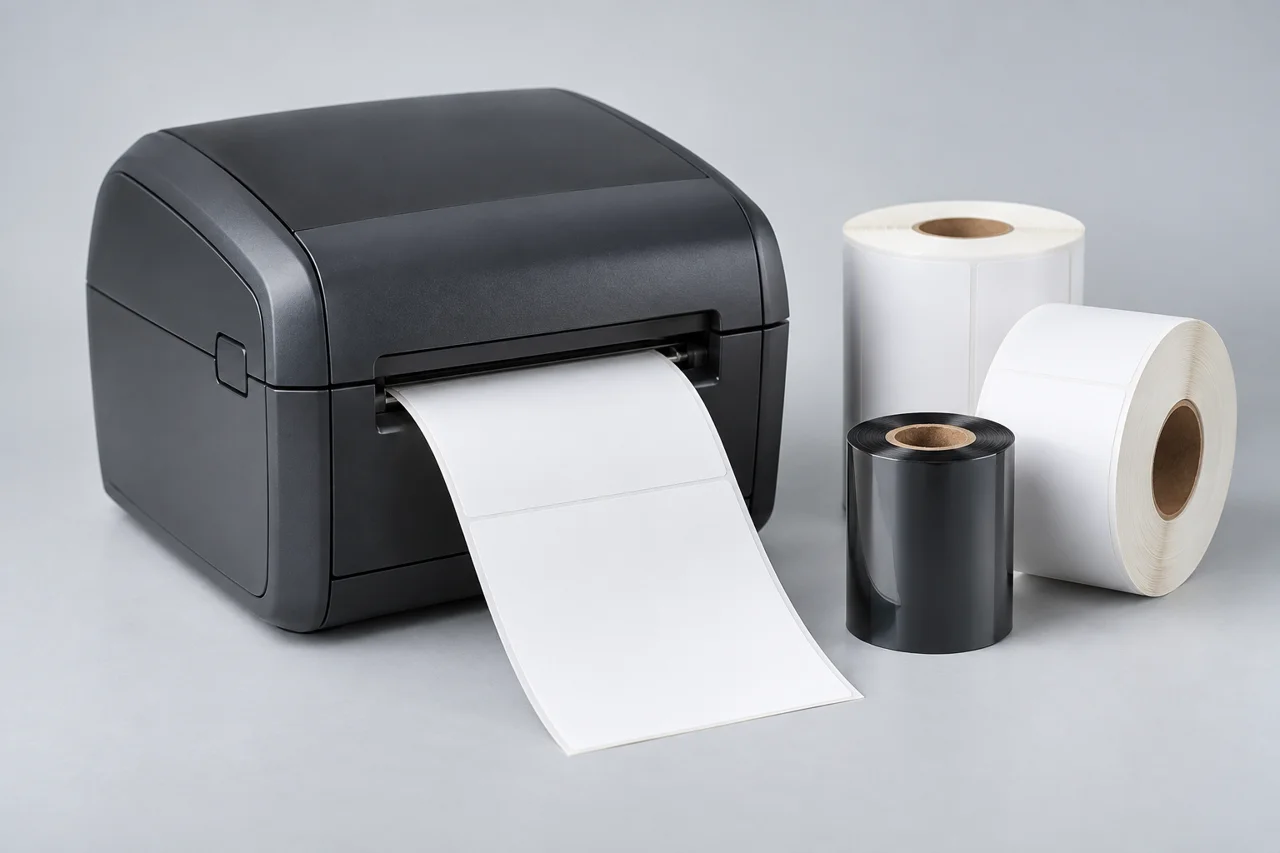
Product image: generated with the built-in ImageGen tool. Brief: an unbranded charcoal concept thermal printer, blank shipping label, two white label rolls and one ribbon roll on a cool-grey studio surface; no text, logos or real-model claims. Asset: hero.webp.
Explore the interactive prototype